Re-use your cogeneration to reduce electrical consumption, emissions and costs
Trigeneration combines a highly efficient and low-emission CHP power generation with an absorption chiller.
In some instances the heat utilisation of a Cogeneration system is highly seasonal. With the addition of an absorption chiller, additional waste heat from the Cogeneration system can be converted into chilled water for use in cooling processes.
Evo’s absorption chillers offer an impressive alternative to electric chillers with plenty of economic and environmental benefits – these include dramatically increased energy efficiency reduction of HCFC/CFC refrigerants, and reduced overall carbon emissions.
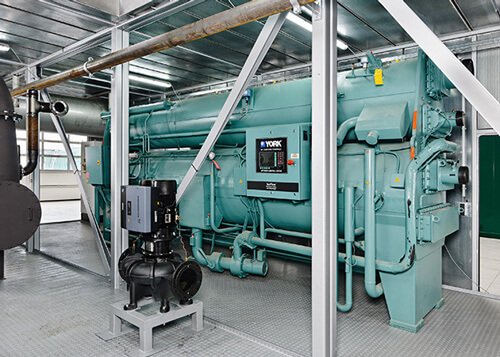
How it Works
The combination of a Cogeneration plant with an absorption refrigeration system, efficiently uses excess heat for cooling.
Electricity

Heat
Chilled Water
- Hot water from the cooling circuit of the Cogeneration plant drives energy for the absorption chiller.
- The hot exhaust gas from the gas engine can be used as an energy source for steam generation.
- Steam can then be used as an energy source for a highly efficient, double-effect steam absorption chiller.
- Use up to 80% of the plant’s thermal output for chilled water
Additional Thermal Energy Solutions
In addition to absorption chillers, Evo Energy Technologies also offer a wide variety of other thermal energy systems.
- Pressurised hot water
- Steam generators
- Thermal oil applications
- Hot air generation
- ORC (organic rankine cycle) power generation
- Heat recovery technologies
- Heat pump systems (In air-to-air, air-to-water and water-to-water configurations)
Our specialist team of engineers create fit- for-purpose energy solutions to meet your specific requirements.


At the forefront of technology and precision, our world-class sales and engineering team deliver sustainable solutions that redefine industry standards

Evo Energy Technologies acknowledges the Traditional Owners of Country throughout Australia and recognises their ongoing connection to land, waters and community. We pay our respects to Elders past and present, and acknowledge the Jagera, Yuggera and Ugarapul peoples of the Yugara/Yagara Language Group, the Traditional Owners of the land on which our head office is located.
© 2023 Evo Energy Technologies All Rights Reserved.
Website designed by Balar Media Group
Company
Applications
Solutions
Policies
Connect
12 Gliderway St, Bundamba QLD 4304
Ph: 1300 012 471
What is trigeneration?
Trigeneration is cogeneration with a third output. A cogeneration plant turns one fuel into electricity and useful heat. A trigeneration plant adds an absorption chiller, so part of that recovered heat is turned into chilled water as well. One gas engine then supplies a site's electricity, heating and cooling, which is why trigeneration is also called combined cooling, heat and power (CCHP).
The point is to keep the engine's heat useful all year. Many sites need plenty of heat in winter and little in summer, so a cogeneration plant can end up with heat it cannot use for months at a time. With an absorption chiller the summer heat becomes cooling instead, the plant runs more hours at full efficiency, and the payback improves.
How a trigeneration plant works
- A 2G gas engine, running on natural gas or biogas, drives a generator that supplies the site's electricity.
- Heat exchangers recover heat from the engine's cooling circuit and exhaust as hot water, or as steam from the exhaust.
- In the heating season that hot water or steam goes to the site's heating, hot water or process loads.
- In the cooling season it drives an absorption chiller, which uses heat rather than electricity to produce chilled water for air conditioning or process cooling. A double-effect steam absorption chiller can use up to 80% of the plant's thermal output for chilled water.
- The site's electric chillers and boilers stay in place for peaks and backup, but run far less.
Where trigeneration fits in Australia
- Cold storage and food production, where refrigeration runs all year. At NewCold Truganina in Melbourne, Evo's 1 MW 2G cogeneration system is paired with an absorption chiller so the recovered heat supports the cold store's cooling. See the project.
- Horticulture and greenhouses, which need heat, power and CO2 for growing and cooling for the packing and storage areas, as at Queensland Plants and Flowers.
- Aquatic and leisure centres, with pool heating in winter and air conditioning in summer.
- Hospitals, hotels and data centres, where cooling is a large, constant electrical load and reliable on-site generation matters.
Frequently asked questions
What is the difference between cogeneration and trigeneration?
Cogeneration produces electricity and heat. Trigeneration produces electricity, heat and cooling, by adding an absorption chiller that runs on the recovered heat. The engine and generator are the same; the difference is what the heat is used for.
Can trigeneration be added to an existing cogeneration plant?
Yes. An absorption chiller can be added to a cogeneration plant that already has unused heat, which is the usual way a site moves from cogeneration to trigeneration.
When does trigeneration make sense instead of cogeneration?
When the site has a large cooling load, or when its heat demand is seasonal and the engine would otherwise run short of useful heat in summer. If a site can use all of the recovered heat all year, cogeneration alone is usually the simpler choice.
What fuel does a trigeneration plant use?
The same as any 2G plant: natural gas from the network, biogas produced on site, or hydrogen. See natural gas CHP and biogas power generation.
How big can a trigeneration plant be?
2G engines range from 20 kW to 4,000 kW and can be combined in multi-unit plants. The chiller is sized to the site's cooling load and the heat available from the engine, which Evo's engineers model from the site's actual energy data.
To find out whether trigeneration suits your site, call 1300 012 471 or contact Evo Energy Technologies. Read more in our guide to combined heat and power.